


By Adiba Hasan
Globally, Canada is a known immigration destination. Domestically, significant political and public attention is given to Canada’s target immigration levels, but also the challenges newcomers face after their arrival. In general, little attention tends to be given to the number of immigrants choosing to become Canadian citizens. The ICC recently published 2021 data from Statistics Canada revealing citizenship rates among recent adult immigrants have decreased drastically over time. The data from 2021 show that only 45.7% of permanent residents became citizens within 10 years – a 40% decline in the naturalization rate for this cohort since 2001.
This decline raises questions about the value of Canadian citizenship. Why are so many PR holders deciding not become citizens after they are eligible?
A recent federal government proposal could potentially change the way that citizenship ceremonies are administered, factors that the ICC’s co-founder, The Right Honourable Adrienne Clarkson argues will contribute to an overall decrease in the desirability of Canadian citizenship. The decline of the naturalization rate is worrisome for Canada due to our dependence on immigration for population growth but also cultural dynamism. It further raises questions about how Canada is perceived amongst recent newcomers.
Given the significant decline in the proportion of newcomers becoming citizens, the ICC will be exploring the reasons behind the decline in naturalization rates. Until then, this analysis is based on the Citizenship and Immigration Dashboard that explores citizenship and permanent residence levels over the past few years.
Citizenship Comparison: 2018 – 2022
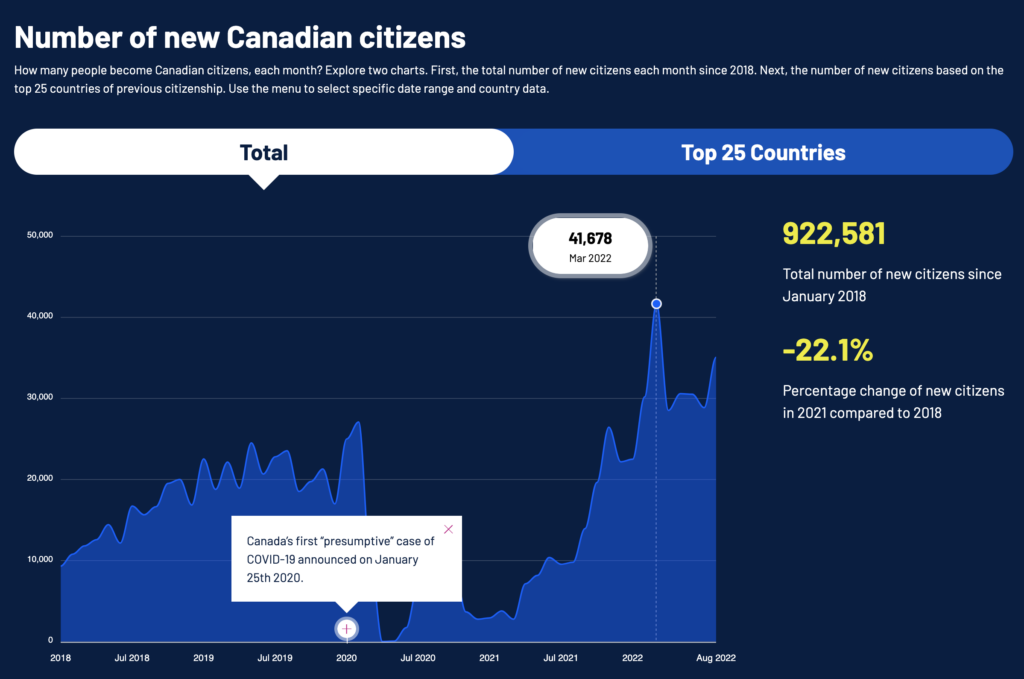
The trend lines in our Citizenship and Immigration Dashboard depict a steady increase in immigration levels, except for the significant drop in 2020 caused by the Covid-19 pandemic. As IRCC revamped and powered through significant backlogs, 2022 experienced the highest citizenship numbers with an uptick in March where Canada received 41,678 new citizens.
Overall in 2022, the citizenship numbers started off weak but ended on a strong note as Canada welcomed 369,153 new Canadian citizens (see top 15 source countries below), a significant rise since 2021 when only 136,732 Canadian citizens were granted. It’s important to note that while the annual figures below show a generally positive trend in the number of new citizens each year, the overall proportion of permanent residents becoming citizens is in decline.
2022
2021
2020
2019
2018
Citizenship versus Permanent Residence in 2022
As IRCC reported, 2022 ended on a high note with a record number of permanent residents as seen in the graph below. However, the number of permanent residents becoming citizens has not received much attention. This chart shows the increased levels of permanent residents in 2022, but citizenship numbers are lower in comparison. While June, July, and September saw a high admission of permanent residents, citizenship numbers were lower than in the other months.
Citizenship by Source Country (2018-2022)
The Citizenship and Immigration Dashboard, which is built on a 2018 baseline, shows trends in the number of new Canadian citizens by source country. The chart below shows the Top 15 source countries, where the lowest source country (Bangladesh) had more than 5,000 new Canadian citizens admitted. India and the Philippines have ranked as the top countries of origin for the past 5 years, while the United States, Pakistan, Iran, and China have closely leveled with one another over the years.
As the ICC continues its exploration of the decline in naturalization rates, do you have a perspective on why fewer permanent residents are choosing to become Canadian citizens? Take a look at our immigration dashboard for updated numbers of PRs and citizens (January 2023 saw the highest number of PRs admitted), and add your voice to the conversation (our social media links are below)!
You can learn more about the ICC here. Join the conversation and be part of building a more inclusive Canada.
Be sure to keep a lookout for our next monthly ICC Immigration Dashboard analysis
Interested in following us? Please sign up here for more updates and follow us to get upcoming content from Ideas & Insights at ICC
According to Statistics Canada, over 7 million women living in Canada were born outside of the country, and in 2022, IRCC welcomed 242,884 female permanent residents, 52% of the total new permanent residents.
In our very own Canoo domain, women also make up 52% of the Canoo member base and in celebration of International Women’s Day, this Canoo Insights Report looks at the usage of Canoo by Canoo women members.
Main takeaways from this report:
- Since 2018, Canoo has served 94,950 women
- Since May 2022, women have saved $1,373,045
Recap: What is a Canoo Insights Report?
Canoo Insights Report is a quarterly series started by Ideas & Insights at the Institute for Canadian Citizenship that sheds light on our Canoo Access Pass program. Through these quarterly reports, we hope to:
- Give readers a sense of the Canoo program
- Reveal the impact of Canoo on its diverse members
- Provide a glimpse into the moving parts of the Canoo program that make it the biggest welcome network in Canada
Here are some highlights about Canoo:
$45+ million
in value delivered
450K
newcomers have participated
65K +
newcomers currently active on Canoo

Canoo Members since 2018: 222,280
Women Members since 2018: 94,950
222,280 people have become Canoo members since Canoo transitioned from a paper pass into a mobile app in 2018. Since then, Canoo has served 94,950 women.
There are 65,690 currently active Canoo members participating in the program within their 12 months of access (a 25% increase from the previous Canoo Insight Report), and 33,226 of the currently active Canoo members are women.
Gender Distribution of Active Canoo Members
Visits by Canoo Women members
When a Canoo member visits a place or participates in an activity through the app, we refer to it as a “check-in“. Since May 2022, Canoo members have made 78,460 check-ins at places across the country. Women have made up slightly more than 50% of the check-ins.
Check-ins by Canoo women members since May 2022: 40,440
Canoo Women Member Check-ins by Status
- A majority of women member check-ins have been made by citizens. Canoo was originally available only to new citizens and in May 2022, permanent residents became eligible to join Canoo.
Time of Day Check-in by Canoo Women Members
- Majority of Canoo women members (55%) check-in in the evening, while 44% check-in in the afternoon. The morning is not popular among our Canoo members and only 59 women checked in the morning.
Dollar Value Delivered by Canoo
Canoo delivers significant value to members by offering heavily discounted or free access to events, places, and lots of activities across Canada. According to a recent survey of 5,000 Canoo members (of which 54% were women), approximately 45% of members express that affordability is the most significant barrier they face when accessing activities.
$ 2,643,452
overall value saved by all Canoo members since May 2022
$ 1,373,045
overall value saved by Canoo Women members since May 2022
Dollars Saved by Women per Province
Top 5 Places Visited by Canoo Women Members
Through Canoo, women members have access to a variety of places across Canada. In every province and territory, women members can choose to visit museums, parks, events, and more. Here are some of the most popular places visited by Canoo women members in Canada.
Since May 2022, Canoo women members checked in 4,290 times to the top 5 places in Alberta.
Value saved from visits to the top 5 places:
Since May 2022, Canoo women members checked in 1,732 times to the top 5 places in British Columbia.
Value saved from visits to the top 5 places:
Since May 2022, Canoo women members checked in 845 times to the top 5 places in Manitoba.
Value saved from visits to the top 5 places:
Since May 2022, Canoo women members checked in 599 times to the top 5 places in Nova Scotia.
Value saved from visits to the top 5 places:
Since May 2022, Canoo women members checked in 14,066 times to the top 5 places in Ontario.
Value saved from visits to the top 5 places in ON:
Since May 2022, Canoo women members checked in 2,053 times to the top 5 places in Quebec.
Value saved from visits to the top 5 places:
Since May 2022, Canoo women members checked in 107 times to the top 5 places in Saskatchewan.
Value saved from visits to the top 5 places:
Did you find this report Interesting? If you want to read more, check out some of the earlier issues of Canoo Insights Report that highlight Canoo partners and members:
As Canoo is evolving and becoming better every day, we hope that these quarterly reports help readers to understand what Canoo is, who are the people that Canoo serves, and get to know some of the partners and services that ultimately bring Canoo to life for newcomers.
Interested in following us? Please sign up here for more updates happening at the ICC and follow us to get upcoming content from Ideas & Insights at ICC.
The latest immigration data (December 2022) has been released by IRCC and the complete 2022 data updates can be found on our immigration dashboard. Data are released by IRCC on a two-month lag. The visualizations below are based on a 2018 baseline.
The number of new citizens in December 2022 was down by 37% (-13,172) compared to November 2022.
Permanent resident admissions in December 2022 were down by 10.20% (-2,585) compared to November 2022.
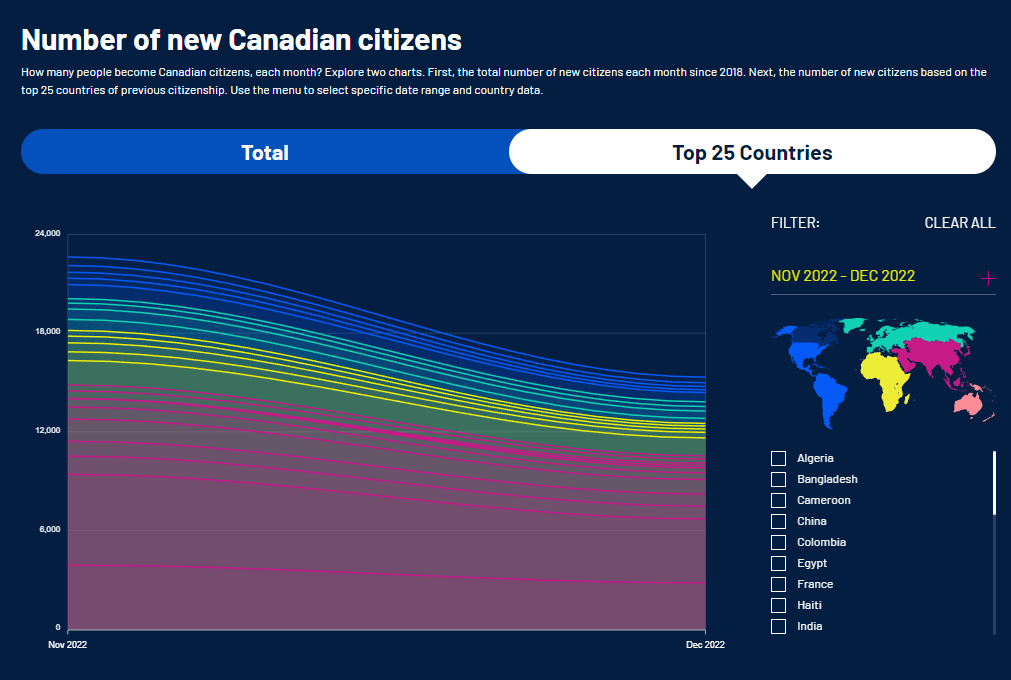
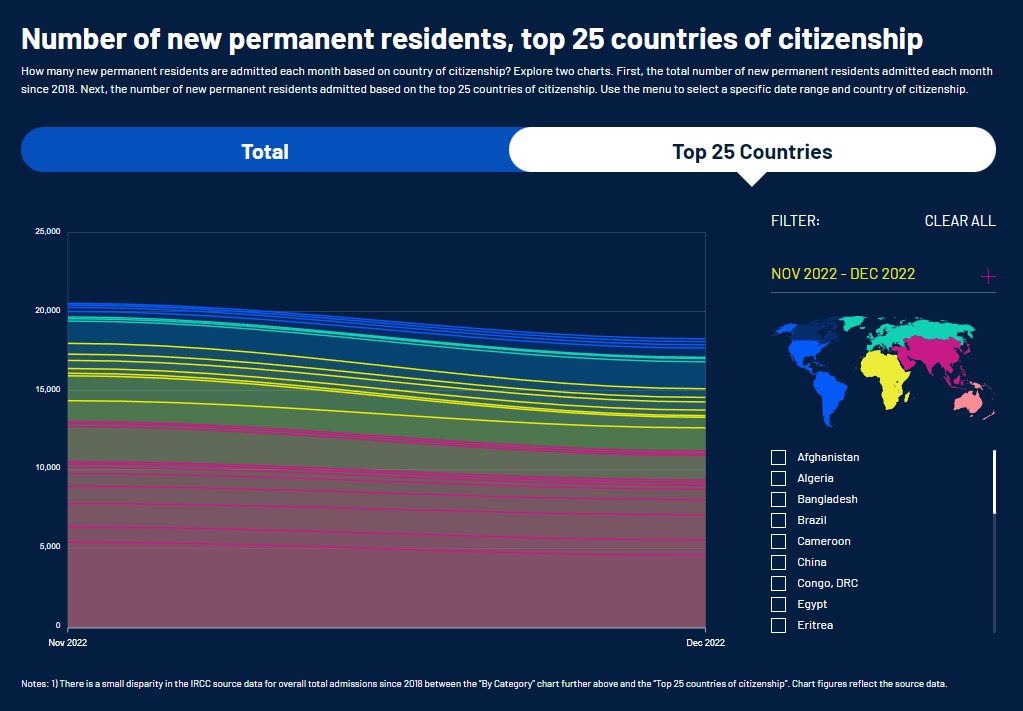
Key Insights – Source Countries
Source Countries (December 2022)
- India represented the largest source country of new citizens (3,886) and permanent residents:(4,555).
- China did not make the list of top 5 source countries for new citizens (735), but was the third largest source country for new permanent residents (1,595).
You can learn more about the ICC here. Join the conversation and be part of building a more inclusive Canada.
Interested in following us? Please sign up here for more updates happening at the ICC and follow us to get upcoming content from Ideas & Insights at ICC.
FOR IMMEDIATE RELEASE
Toronto, ON
The percentage of permanent residents obtaining Canadian citizenship has plummeted since 2001, according to new Statistics Canada data obtained by the Institute for Canadian Citizenship.
Despite Canada’s efforts to attract growing numbers of newcomers, the proportion of immigrants who seize the opportunity to become Canadian is in freefall. Data collected during the 2021 Census reveal that just 45.7% of permanent residents became citizens within 10 years, down from 60% in 2016 and 75.1% in 2001. This represents a 40% decline in citizenship uptake over 20 years.
These numbers were shared by Statistics Canada with the Institute for Canadian Citizenship as part of ongoing research into declining citizenship rates.
“To go from 75% of newcomers obtaining citizenship to only 45% is simply shocking,” said Daniel Bernhard, CEO of the Institute for Canadian Citizenship.
“To go from 75% of newcomers obtaining citizenship to only 45% is simply shocking”
Daniel Bernhard, CEO of the Institute for Canadian Citizenship
“It goes against everything we tend to think about Canada being a welcoming country. It raises all sorts of questions that will have no easy answers, but it is certainly a wakeup call. Canada’s future depends on newcomers becoming Canadian and contributing their energy and talents to our shared success. We should be extremely alarmed that newcomers are falling out of love with Canadian citizenship, which has, for decades, been highly desirable.”
“The declining citizenship rate has the potential to harm Canada’s long-term economic, social and democratic resilience. Immigrants are not just workers, but future voters and civic leaders. What’s certain is that the future of Canadian democracy depends on this issue being addressed. The ICC is working hard to identify the causes behind this apparent crash in the market value of being Canadian and we encourage all committed Canadians to join us.” said George Carothers, Senior Director, Ideas and Insights at the ICC.
“We should want those who are contributing to Canada to stay here and become citizens,” he concluded.
“We should want those who are contributing to Canada to stay here and become citizens”
George Carothers, Senior Director, Ideas and Insights of the Institute for Canadian Citizenship
Thanks to its Canoo Access Pass, the ICC is in touch with almost half a million recent immigrants. The ICC will be working with them over the coming months to better understand the root causes of this shocking decline.
Read more: Trends in the Citizenship Rate Among New Immigrants to Canada 1991 to 2016 (Statistics Canada, 2019)
About
The Institute for Canadian Citizenship (ICC) works to unlock Canada for newcomers, facilitating and encouraging the journey towards full and active Canadian citizenship. The ICC is an independent charity, co-founded in 2006 by the Rt. Hon. Adrienne Clarkson and John Ralston Saul.
Media Contact
Alex Nanoff
613.709.6318
media@forcitizenship.ca
By Adiba Hasan
Immigration is vital to Canada’s economy, but also to its cultural dynamism. 90 percent of labour force growth is attributed to immigration, as is 75 percent of population growth. Canada has welcomed a record high of 431,645 new permanent residents in 2022, 16% higher than in 2021. But the federal government has indicated that it will increase immigration levels even further, admitting 1.45 million new immigrants between 2023-2025.
The ICC launched a dashboard in collaboration with Andrew Griffith, tracking the number of new citizens and permanent residents admitted to Canada. After facing public backlash on application backlogs, IRCC has managed to surface through and meet its target for the year. Here is the overall breakdown of permanent resident numbers in 2022:
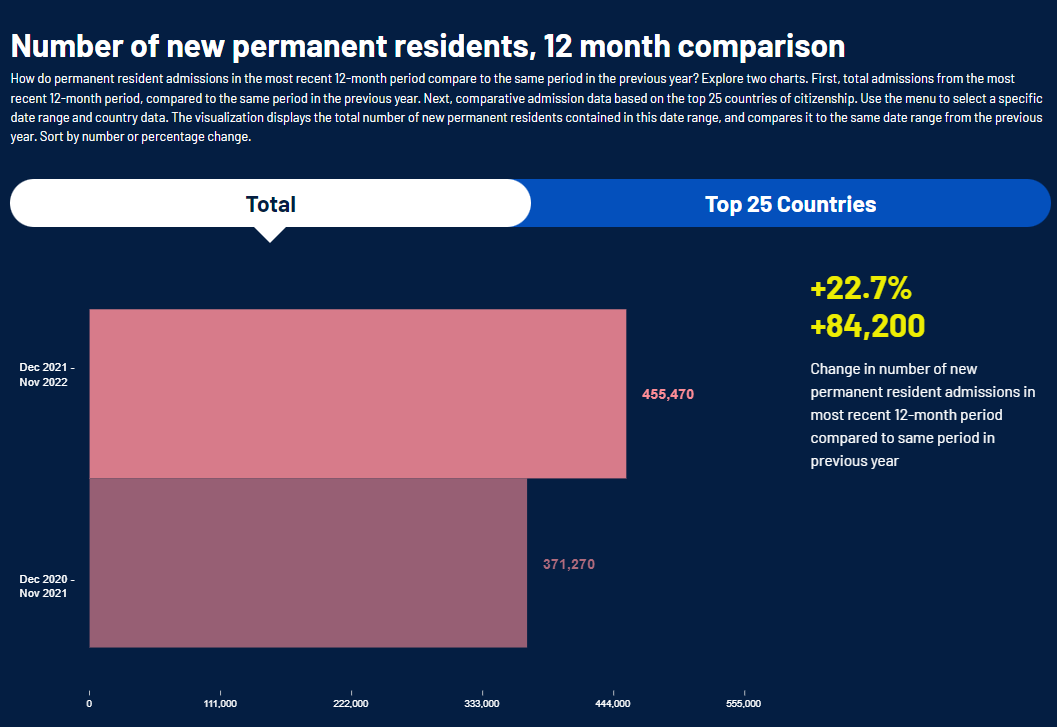
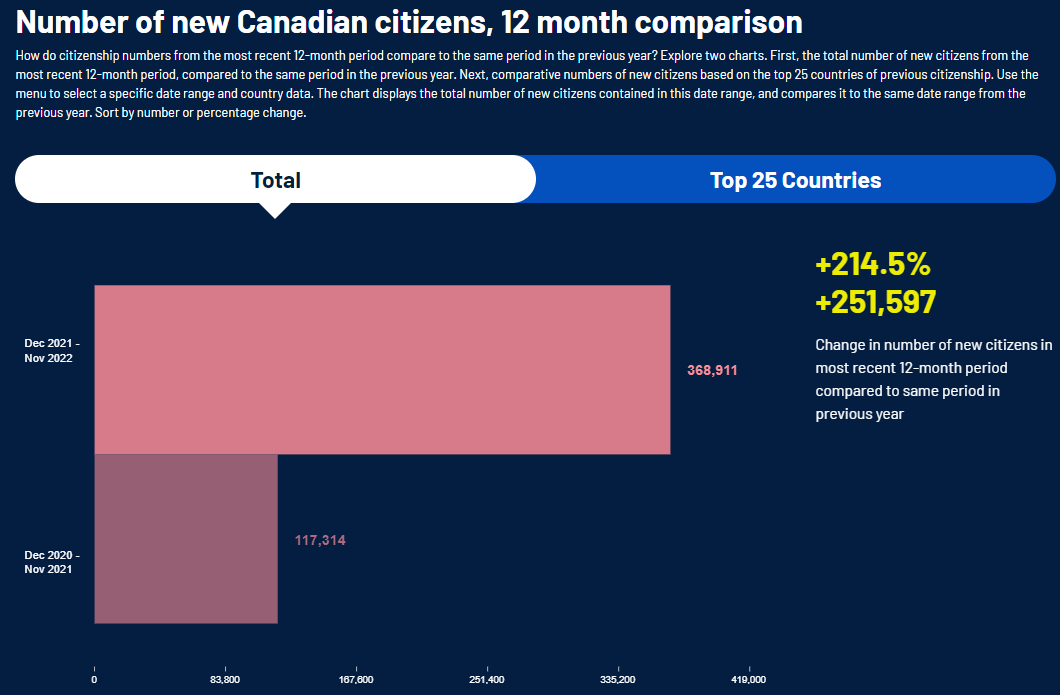
As seen from the dashboard, the number of permanent residents admitted between December 2021 – November 2022 is 22.7 percent higher than the previous year. The dashboard below shows how the admission varies from month to month in each immigration stream:
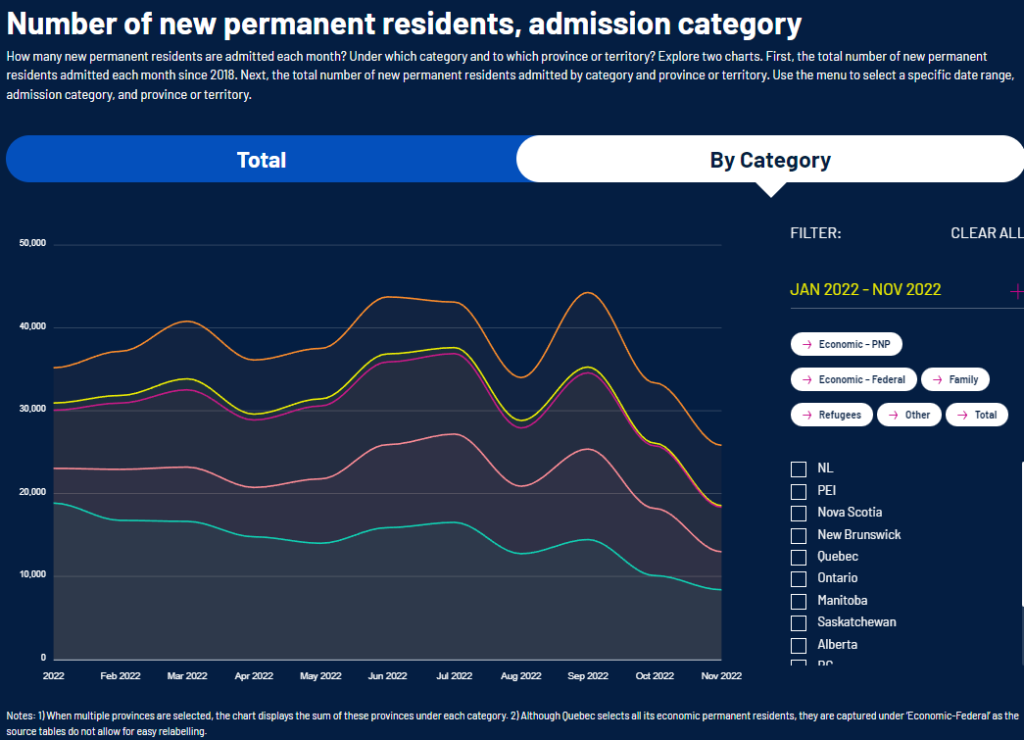
Reviewing the dashboard on permanent resident admission categories in 2022, the dashboard shows how admission numbers vary considerably over time. For example, the Economic-Federal category (line in green) represented most admissions processed in early 2022, but monthly figures for this category decreased significantly throughout the year. The number of permanent residents admitted through the Economic-Federal category fell from almost 19,000 permanent residents in January 2022 to roughly 8,400 in November 2022.
For new citizens, the dashboard shows similar variations in monthly processing. The drastic fall in the number of new Canadian citizens at the beginning of the pandemic and the unpredictable variation of the trendline since that point reveal IRCC’s struggles in processing citizenship applications while navigating through a massive application backlog. Although the first Covid-19 case announcement was on 25 January 2020, the trends show that the number of new citizens remained relatively steady, with 25,002 new citizens approved in January and 27,094 in February. The trendline dipped in March 2020 as IRCC shut most of its services at the onset of the pandemic. Canada admitted 9,786 new citizens in March 2020 before seeing a collapse in April 2020, when they accepted only 22 citizens.
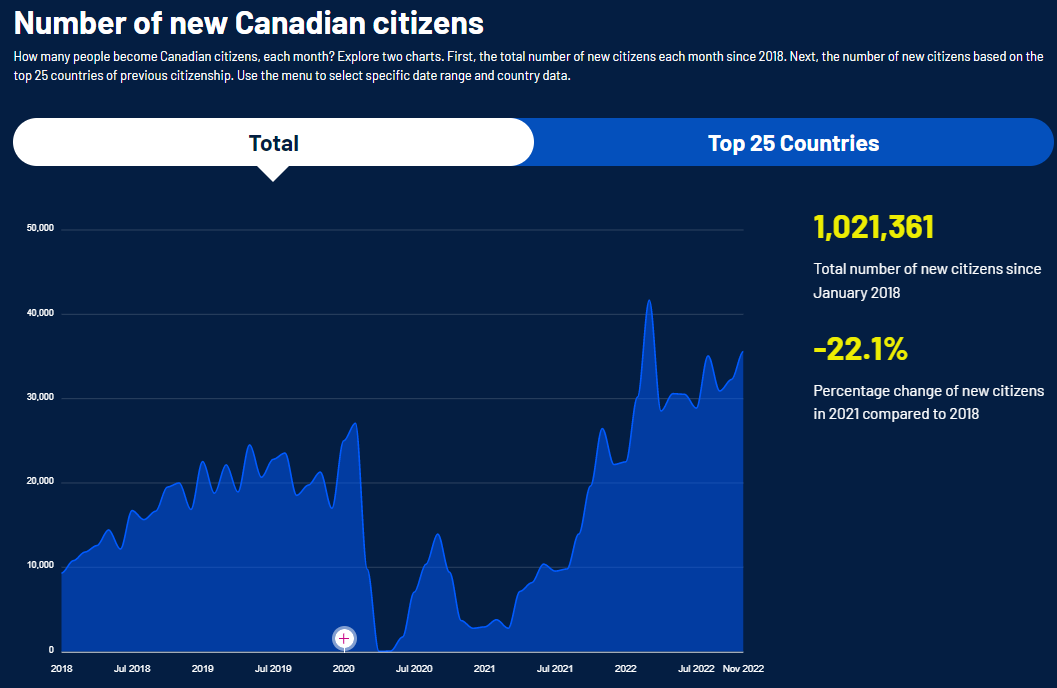
In 2020, Canada admitted only 110,901 new citizens, a 56 percent drop from 2019 when Canada welcomed 250,513 new citizens. In September 2020, IRCC announced a gradual resumption of in-person services and there was a sudden uptick in the trend, admitting 13,936 new Canadians. The trendline of the following months reveals the outcome of the challenges IRCC was facing as the citizenship approval rates continued to vary substantially. IRCC was in the centre of a lot of negative limelight for leaving almost 85,000 potential new Canadians in limbo and experts continue to question and want more transparency on the department’s processes.
Despite all the negative media coverage about IRCC’s lack of resources and ability to manage the backlog, the number of new citizens eventually recovered. Between December 2021- November 2022, Canada gained 368,911 new citizens, a 214.5 percent increase from the 262,803 Canadian citizens approved in the previous year.
While the record number of permanent resident admissions and the significant number of new citizens in the last year is certainly noteworthy, the data raises important questions about the government’s goal of admitting 1.45 million immigrants by 2025. Given the variation in processing from one month to the next, will IRCC be able to reach this goal? Considering the fact that 1.09 million applications are still in the backlog, does IRCC have the capacity, whether through technology or through human labour, to get through the accumulated applications while also taking on a larger volume in the future? Is the goal to bring processing times back to pre-pandemic levels, which were already quite slow, or is it to revamp the entire system with the use of AI, changing eligibility requirements to create a more streamlined process of admitting newcomers in Canada?
The Institute for Canadian Citizenship works to unlock Canada for newcomers through programs like Canoo and through original research initiatives and collaborations, such as the immigration dashboard. Each month, the ICC will be monitoring trends in new citizenship and permanent resident admissions and sharing our analysis with the public. Are you following the national conversation on immigration? Let us know what you think about the 2023-2025 Immigration plan or share your thoughts about the immigration dashboard.
You can learn more about the ICC here. Join the conversation and be part of building a more inclusive Canada.
Interested in following us? Please sign up here for more updates happening at the ICC and follow us to get upcoming content from Ideas & Insights at ICC.
What is a Canoo Insights Report?
This is the next installment of our first Canoo Insights Report, a quarterly series started by Ideas & Insights at the Institute for Canadian Citizenship. Through these quarterly reports, we hope to:
- Give readers a sense of the Canoo program
- Reveal how Canoo is the bridge that unlocks the best of Canada to newcomers
- Give readers a glimpse into the moving parts of the Canoo program that make it the biggest welcome network in Canada
What is Canoo?
Canoo is a distinctly Canadian innovation that translates our country’s openness to newcomers. Through the Canoo app, Permanent Residents and new citizens get a 12-month membership that unlocks free VIP access to over 1400 locations and experiences across Canada.
Learn About the Canoo Members
Canoo was initially offered to new Canadian citizens, who make up the majority of members. With the relaunch of Canoo in May 2022, Canoo is now offered to permanent residents for the first time, and more than 15,000 permanent residents have become members since.
$45+ million
in value delivered
450K
newcomers have participated
> 40%
of members bring children on their visits
Who is eligible to become a Canoo member?
- Any Canadian who received their citizenship in the last 12 months (365 days)
- Are within the first 5 years of receiving permanent residence status
- 18 years or older
Eligible immigrants can download the Canoo app, verify their immigration status, and gain access to tens of thousands of dollars worth of benefits + knowledge on what to do in Canada. The whole process takes less than 5 minutes.
Canoo Member Lifecycle:
Download Canoo
The first step is to download Canoo through Google Play or the App store
Verification
If eligible, members will verify their immigration status on the app by scanning their PR card or citizenship certificate
Activation
Once verified, members can choose when they want the 12-month membership to begin (some may choose to activate later depending on their schedule, upcoming offers they want to use, etc.)
Check-in to Places
Once activated, members gain access to arts and cultural venues, sports events, festivals, and more than 1400+ locations
Canoo Members since 2018: 194,760
Canoo transitioned from a paper pass to a mobile app in 2018. Since becoming digital, Canoo data show that 194,760 people have become Canoo members. Of this, there are 48,250 current active Canoo members.
Time frame: May 6th, 2022 – December 12th, 2022
Total Members Since 2018
| Currently Active PRs | 17,190 |
| Currently Active Citizens | 34,510 |
| Alumni | 102,250 |
| Downloaded | 40,810 |
| Total | 194,760 |
Gender Distribution of Active Canoo Members
| Female | Male | |
|---|---|---|
| PR | 8,950 (52%) | 8,170 (48%) |
| Citizens | 17,190 (50%) | 17,320 (50%) |
1) 67 Permanent Resident Canoo members identified as “no gender” or “non-binary”;
2) 25 citizen Canoo members identified as “no gender” or “non-binary
X-axis: Immigration Status, Y-axis: Canoo Members
Age Distribution of Canoo Members
Canoo serves diverse age groups, but a majority of active members are between 25 to 44 years old: 20,218 females, 19,222 males
| Age | Female | Male |
|---|---|---|
| 18-24 | 1,217 | 953 |
| 25-34 | 9,630 | 8,017 |
| 35-44 | 10,588 | 11,205 |
| 45-54 | 2,696 | 3,324 |
| 55-64 | 763 | 798 |
| 65-74 | 339 | 364 |
| 75+ | 997 | 944 |
X-axis: Age, Y-axis: Canoo Members
Canoo Members with Children
In the last 12 months, the total number of adults admitted to Canoo is more than 50,000 members. Of this, 42 percent of Permanent Residents and 49 percent of new citizens brought children to Canoo partner sites.
| Has Children | No Children | |
|---|---|---|
| PR | 8,081 (47%) | 9,112 (53%) |
| Citizen | 19,684 (57%) | 14,826 (43%) |
X-axis: Immigration Status, Y-axis: Canoo Members
Time of Day Check-in
Most Canoo members, regardless of having children or not, visit places in the afternoon to evening.
X-axis: Time of Day, Y-axis: Canoo Members
Canoo members’ Countries of Origin
Active Users by Country of Origin
X-axis: Country of Origin, Y-axis: Canoo Members
Permanent Residents
(Top 10 Countries of Origin)
5,947
PR Canoo members of Chinese Origin
Citizens
(Top 10 Countries of Origin)
6,922
Citizen Canoo members of Indian Origin
In the last 12 months, the highest number of new citizen members were of Indian origin, while the highest number of permanent resident members were of Chinese origin. These trends in permanent resident and new citizen members are relatable to IRCC data on immigration and citizenship numbers, which are available to the public through the ICC’s immigration and citizenship dashboard here.
Days to Activation
Once a potential Canoo member downloads the app, how long does it take for them to activate their membership?
85% of members activate their membership within the first 30 days, and of those 67% of Canoo members check-in to their first location within the first week of activation.
% of members activating Canoo membership
Stories from Canoo
While empirical data is important, direct narratives from Canoo members are also vital. Toni Agbaje-Ojo, at the ICC, interviewed Canoo members on their experience using Canoo and covered a range of topics, from understanding what their transition to Canada was like to how Canoo helped them find a sense of belonging in Canada.
In conversation, Canoo members identified three transformative experiences:
- Exposure to new experiences, places, and people
- An increased sense of belonging in Canada
- Building memories and relationships within families, between newcomers and Canadians, and between newcomers and the cities they call home
Highlighted below are two Canoo members who explain their journey in Canada and use Canoo to create memories and feel connected to Canada.
As Canoo is evolving and becoming better every day, we hope that these quarterly reports help readers to understand what Canoo is, who are the people that Canoo serves, and get to know some of the partners and services that ultimately bring Canoo to life for newcomers.
Interested in following us? Please sign up here for more updates happening at the ICC and follow us to get upcoming content from Ideas & Insights at ICC.
Welcome to the first Canoo Insights Report
This is the first Canoo Insights Report, which is a quarterly series started by Ideas & Insights at the Institute for Canadian Citizenship. Through these quarterly reports, we hope to:
- Give readers a sense of the Canoo program
- Reveal how Canoo is the bridge that unlocks the best of Canada to newcomers
- Give readers a glimpse into the moving parts of the Canoo program that make it the biggest welcome network in Canada
What is Canoo?
Founded in 2010 and formerly known as the Cultural Access Pass (CAP), Canoo is a distinctly Canadian innovation that translates our country’s openness to newcomers. Through the Canoo app, Permanent Residents and new citizens get a one-year membership that unlocks free VIP access to over 1400 locations and experiences across Canada (e.g., Concerts, arts & culture, travel, volunteering, etc.). Canoo originally served new citizens within their first 12 months of citizenship, but in May 2022, the ICC relaunched Canoo and expanded eligibility to more than two million recently arrived permanent residents.
The Problem
The Canadian government pledges to welcome more than 1.45 million permanent residents between 2023 and 2025 and general support for immigration in Canada remains strong. However, the number of permanent residents choosing to become citizens has dropped significantly since 1996, and a survey commissioned by the ICC in March 2022 showed that 30% of recent newcomers under 35 said they are likely to leave Canada within two years.
Like other countries, Canada depends on immigrants, and without their contributions, Canada will struggle to provide good-quality public services and economic growth will decline.
The Solution
Through Canoo, the ICC is on a mission to unlock the best of Canada so that immigrants don’t just come here, but also see themselves as a part of Canada’s future, love it, and become citizens and equal contributors to the country’s shared prosperity and success.
The goal is to create the best possible experience for newcomers in their early years. The ICC has responded by:
- Expanding the range of benefits available through Canoo
- Opening the program to 2 million permanent residents in May 2022
- Providing opportunities for Canadian institutions and companies to join Canada’s largest welcome network
Who are Canoo Partners?
Canoo partners make up Canada’s largest welcome network; a unique model in the world.
Canoo has two partnership streams:
Canoo offer partners – Canoo’s backbone
Canoo offer partners join the network when they commit to bringing great value to newcomers via Canoo. These partners provide free access or significant discounts to their places, experiences, and products. It is about rolling out the red carpet and showing newcomers in tangible ways that they are welcome and wanted in Canada. In other words, they bring Canada’s welcoming spirit to life.
Canoo enables its offer partners to connect directly with newcomer audiences, the fastest-growing demographic in Canada, along with Indigenous peoples. The partnership also supports Canoo’s offer partners’ diversity and inclusion mandates, helping demonstrate impact in the newcomer sphere internally and externally.
All of Canada’s top cultural institutions and most parks are part of Canoo, as are Canada’s flagship airline, Air Canada, and rail company, VIA Rail. Three of the top five most recognizable Canadian retailers recently joined the network and will start publishing their Canoo offers in 2023.
The ICC’s success rate in securing the participation of major brands we’ve outreached to in 2022 is 100%. This is a testament to Canadians’ commitment to welcoming newcomers. We continue to expand our offering each month, bringing on new corporate, cultural, and civil society partners eager to join the Canoo welcome network.
Canoo’s partnerships with immigrant-serving organizations – Further connecting Canoo & the ICC to the newcomer community
Beginning in May 2022, Canoo has been forming a pan-Canadian network of immigrant-serving organizations, such as settlement agencies. These agencies connect newcomers to Canoo, link Canoo members to agency services, and provide valuable counsel to Canoo’s strategic planning.
Canoo places across provinces and territories
Some Canoo partners offer discounts and free admission to their places. These places are situated across all provinces and territories.
| Places per Province | No. of Sites |
|---|---|
| Other (parks, historical sites, museums, art galleries, festivals, theatres) | 340 |
| Ontario | 268 |
| Nova Scotia | 51 |
| British Columbia | 50 |
| Quebec | 50 |
| Alberta | 46 |
| Saskatchewan | 23 |
| Manitoba | 21 |
| Newfoundland and Labrador | 18 |
| New Brunswick | 11 |
| Northwest Territories | 7 |
| Yukon | 7 |
| Prince Edward Island | 4 |
| Nunavut | 3 |
Canoo partners by category
Canoo partners range from provincial parks and festivals such as the Vancouver International Film Festival, Calgary Stampede, and the Toronto Film Festival, and many discounted and free offers to venues and activities like museums, science centres, and art galleries. In 2022, Air Canada, Canada’s national airline joined Canoo to expand the program’s travel offerings with VIA Rail who’s been with Canoo since 2012. These travel offerings allow Canoo members to discover Canada barrier-free beyond their place of residence.
Places by Category
| Place Category | No. of Places |
|---|---|
| Park | 516 |
| Museum | 165 |
| Historic Site | 121 |
| Art Gallery | 69 |
| Theatre | 11 |
| Science Centre | 7 |
| Sports | 3 |
| Aquarium | 1 |
| Convention Centre | 1 |
| Festival | 1 |
| Library | 1 |
| Zoo | 1 |
Top 5 visited places by Province
Time frame: May 6th, 2022 – December 7th, 2022
Since the relaunch of Canoo in May 2022, Heritage Park Historical Village was the topmost visited site by Canoo members with 1,944 adults and 2,201 children. A living history museum and educational centre located in Calgary, the Heritage Park Historical Village exhibits western Canada from 1860s to 1950s along with amusement rides, restaurants, and event venues.
TELUS Spark Science Centre became the top most visited site for Canoo members with children, welcoming 2,319 children. An interactive science museum that has the largest dome theatre and ignites curiosity in the world of science, technology, and innovation.
Alberta: Top 5 Places Visited
Alberta: Top 3 Places Children Visited
In addition to the places featured in the above graphs, Canoo members received 500 free tickets to the 2022 Calgary Stampede, hundreds of complimentary and discounted tickets to performances by the Alberta Ballet, Calgary Opera, and Calgary Philharmonic Orchestra, dozens of free tickets to the 2022 Calgary Folk Music Festival, and unlimited discounted tickets to Calgary International Fringe Festival.
The Vancouver Art Gallery was the top visited site by Canoo members with 413 adults. It is recognized as one of North America’s most innovative visual arts institutions that gives space and focus to First Nations artists and the art of the Asia Pacific region.
Science World recently joined Canoo in September 2022 and became the top visited site for Canoo members with children, welcoming 264 children. Science World is an interactive museum that attracts children with its live science demonstrations.
BC: Top 5 Places Visited
BC: Top 3 Places Children Visited
In addition to places featured in the above graphs, Canoo members received 400 free tickets to the 2022 Vancouver International Film Festival, with 200 additional free tickets being offered for their year-round film screenings. Members also received discounted paddling lessons with Dragon Boat BC, exclusive tickets to BC Lions sports matches, 75 free tickets to Ballet BC’s opening show of the season, and regularly-offered complimentary tickets to performances at Vancouver Island’s Belfry Theatre
Since the relaunch of Canoo in May 2022, Manitoba Children’s Museum was the most visited site in Manitoba – 403 adult Canoo members and 541 children. It is housed in the oldest train repair facility in Manitoba and it “exists to spark kids’ creative learning”.
Manitoba: Top 5 Places Visited
Manitoba: Top 3 Places Children Visited
Since the relaunch of Canoo in May 2022, the Maritime Museum of the Atlantic was the topmost visited site by Canoo members with 281 adults in Nova Scotia. One of the oldest and largest maritime museums in Canada, it hosts a large collection of elements that highlight the province’s marine history.
The Discovery Centre is the top most visited site by Canoo members with children, welcoming 221 children. It is an interactive science museum located on the Halifax waterfront.
Nova Scotia: Top 5 Places Visited
Nova Scotia: Top 3 Places Children Visited
Since the relaunch of Canoo in May 2022, the Toronto Zoo was the topmost visited site by Canoo members with 4,043 adults who brought along 3,502 children on their visits.
Ontario: Top 5 Places Visited
Ontario: Top 3 Places Children Visited
Canoo members have had access to incredible events and experiences in Ontario such as:
- 1000s of free concert & show tickets offered by MLSE such as Amy Schumer, Disney on Ice, Eagles, Leon Bridges, and many more. Along with shows and concerts MLSE has also offered free and discounted tickets to check out sports matches for the Toronto Football Club, the Argonauts, and the Toronto Marlies
- 1000’s of free and discounted performance tickets to the National Ballet, Toronto Symphony Orchestra, Canadian Opera Company, London Symphonia, Tarragon Theatre more
- Discounts to amazing immersive experiences with Lighthouse immersive
- Free tickets and membership to a variety of different Festivals such as the Toronto International Film Festival, HotDocs Film Festival, Toronto Fringe Festival, Syria Film Festival, Inside Out
- Canoo members have had access to learning how to camp and explore Ontario Parks with the Ambassador program offered by Ontario Parks
- Experience workshops for kids and parents alike with Little Canada, Aurora Cultural Centre, Robert McLaughlin Gallery
Since the relaunch of Canoo in May 2022, Montréal Museum of Fine Arts attracted the most Canoo members with 639 adults. It is the oldest museum in Canada (founded in 1860), comprising over 45,000 artworks showcasing Quebec, Canadian heritage, and international art.
The Montréal Science Centre is situated in the heart of Old Port of Montréal and attracted 416 children of Canoo members. The centre includes interactive, innovative, and educational activities and creates a scientific space filled with fun and wonder.
Quebec: Top 5 Places Visited
Quebec: Top 3 Places Children Visited
A network of four museums in Saskatchewan, the Western Development Museum attracted the most Canoo members to learn about the social and economic development of the province.
Since the relaunch of Canoo in May 2022, the Western Development Museum was visited by 69 adults and 103 children.
Saskatchewan: Top 5 Places Visited
Saskatchewan: Top 3 Places Children Visited
As Canoo is evolving and becoming better every day, we hope that these quarterly reports help readers to understand what Canoo is, and get to know some of the partners and services that ultimately bring Canoo to life for newcomers. Stay tuned for Canoo Insights: Part 2 which will be published on December 13th, 2022.
Interested in following us? Please sign up here for more updates happening at the ICC and follow us to get upcoming content from Ideas & Insights at ICC.
Labour shortages and processing backlogs have sparked lively debates about the impact of COVID-19 on Immigration, Refugees and Citizenship Canada (IRCC). These debates also highlight the need for greater access to information. Through a collaboration with expert Andrew Griffith, the ICC is bringing monthly immigration and citizenship data to the public through a new dashboard.
In the early days of the COVID-19 pandemic, Dan Hiebert (University of British Columbia) and Howard Ramos (Western University) were speculating about the possible impact of COVID-19 on immigration and citizenship in Canada. These discussions highlighted the unique value and importance of data and ultimately led to monthly tracking of IRCC data across the full range of programs: Permanent Residents, temporary workers, settlement services, international students, citizenship, and visitor visas.
The importance of data was made visible during the citizenship backlogs in the early 2000s and 2010s, which prompted the respective governments to increase funding to IRCC to reduce large backlogs.
We were curious how COVID-19 would change the complex set of push and pull factors that incentivize migration. Put simply, source countries have attributes that make life look more attractive abroad and host countries have features that attract newcomers. For instance, a weak economy or poorer quality of life at home compared to good jobs and good health abroad.
Monthly tracking of data would allow us to observe the downstream impact of COVID-19 on the number and origin of people moving through Canada’s various immigration and citizenship programs delivered through IRCC.
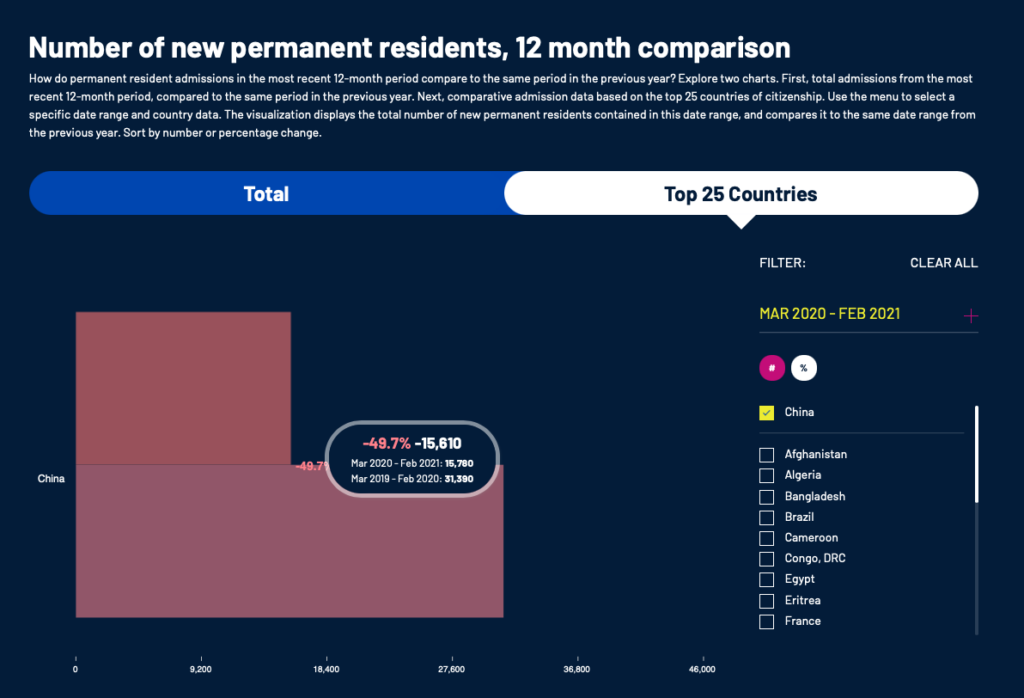
As it happened, the data revealed that COVID-19 did not significantly affect immigration source countries apart from China, where Chinese government restrictions and policies resulted in an ongoing decline compared to other countries.
In the end, it was the Canadian government’s immigration policy response after the initial shutdowns and restrictions that had a much greater impact on immigration and citizenship than our relative handling of COVID-19.
The government’s response included both short-term measures to address particular pressure points such as seasonal agriculture workers, greater flexibility for international students for remote study, and perhaps most significantly, the vast expansion of temporary residents transitioning to permanent residency (TR2PRR).
Picking up on earlier plans stalled by the pandemic, the government took full advantage of the opportunity to implement substantial increases in immigration levels, with the most recent plan committing to welcome 500,000 new permanent residents in 2025.
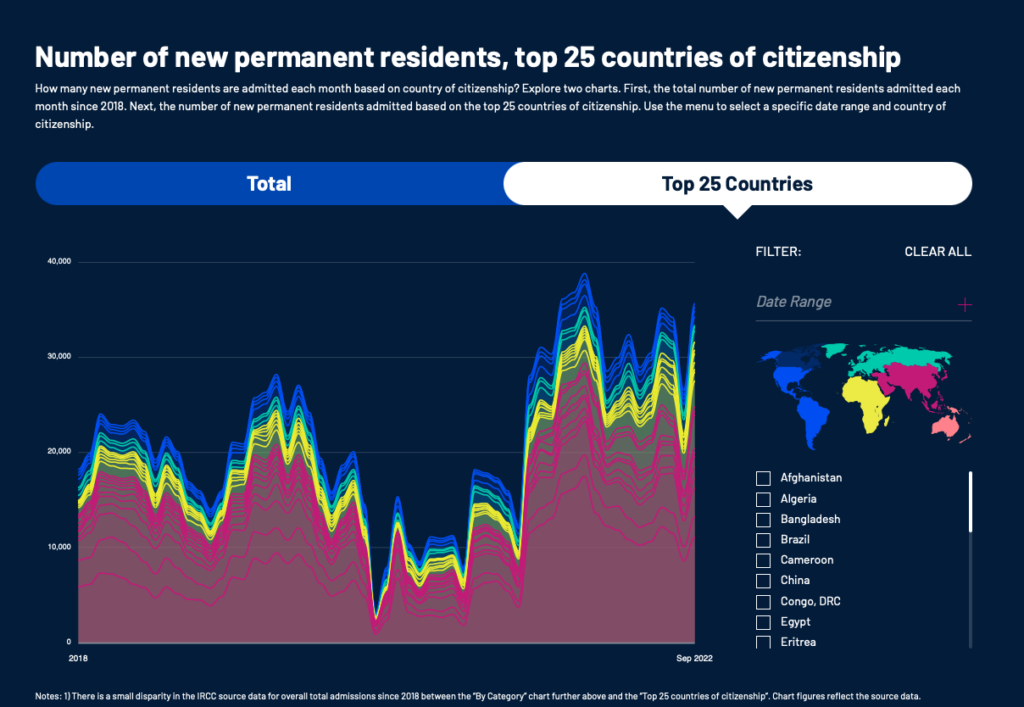
The citizenship program, briefly shut-down, moved to a mix of virtual and in-person citizenship ceremonies and has recovered to pre-pandemic levels.
Medium and longer-term measures included more online applications and tracking along with IT, AI, and associated investments to improve processing.
Each of these responses had an impact on the people moving through IRCC’s immigration and citizenship programs. But to what degree? The observable change can only be seen in IRCC’s monthly data tables, which remain complex and unapproachable to most.
The goal of this dashboard is to make basic immigration and citizenship data more readily available and accessible to the public. It focuses on permanent residents and new citizens in terms of overall numbers, immigration categories, the countries of citizenship and the year-over-year change. Application data is not included given the approximately six-month time lag. IRCC web data provides a sense of interest in immigrating to Canada and becoming a citizen.
The data series starts in 2018, two years prior to the start of COVID-19, and tracks the impact of COVID-19 and the related effects of the government policy and program responses to COVID-19.
Now, more than two years later, most of Canada’s immigration programs have recovered from the depths of COVID-19 health and travel restrictions.
A more in-depth analysis of COVID-19’s impact and Canadian immigration and citizenship’s recovery can be found in my article, “How the government used the pandemic to sharply increase immigration“.
The hope is that this dashboard will help to spark, substantiate, and contextualize more conversations about immigration and citizenship in Canada.
Andrew Griffith is the author of “Because it’s 2015…” Implementing Diversity and Inclusion, Multiculturalism in Canada: Evidence and Anecdote and Policy Arrogance or Innocent Bias: Resetting Citizenship and Multiculturalism and is a regular media commentator and blogger. Find him on Twitter: @Andrew_Griffith
MARCH 23, 2022 – A new national survey conducted by Leger on behalf of the Institute for Canadian Citizenship (ICC) — Canada’s leading citizenship organization and the world’s foremost voice on citizenship and inclusion — challenges some cherished Canadian assumptions about immigration and citizenship.
“Canada is a nation of immigrants — and one of the stories we tell ourselves is that we are welcoming to new immigrants, wherever they may be from,” says ICC CEO Daniel Bernhard. “But while this may be generally true, new survey data points to the fact that many new Canadians are having a crisis of confidence in Canada — and that should be ringing alarm bells all over Ottawa.”
Survey findings include:
- 30% of 18–34-year-old new Canadians and 23% of university-educated new Canadians say they are likely to move to another country in the next two years.
- While most Canadians and new immigrant Canadians alike believe that Canada provides immigrants with a good quality of life, Canadians have a much more positive outlook on Canada’s immigration policy compared to new Canadian immigrants.
- New Canadian immigrants are more likely to believe that Canadians don’t understand the challenges that immigrants face and feel the rising cost of living will make immigrants less likely to stay in Canada.
- Immigrants with university degrees tend to have less favourable opinions on matters related to fair job opportunity and pay than other immigrants.
- Among those who would not recommend Canada as a place to live, current leadership and the high cost of living were the top two reasons.
The full survey data is available here.
“The data suggest that younger, highly skilled immigrants in particular are starting to fall between the cracks,” said Dave Scholz, Executive Vice-President at Leger. “We need to continue working hard to ensure that we are welcoming newcomers with the resources they need to succeed, and that we continue to be a country that provides opportunity.”
About the Study
The study included an online survey of 1,519 general population Canadians aged 18+ completed between February 25th – 27th 2022, using Leger’s online LEO panel, in addition to an online survey of 2,103 New Canadians using ICC’s New Canadian panel completed between February 24th – 28th. Weighting has been employed to ensure that the sample composition accurately reflects the adult population of Canada, as per the latest Census Data.
No margin of error can be associated with a non-probability sample (i.e. a web panel in this case). For comparative purposes, though, a probability sample of 2000 respondents would have a margin of error of ±2.5%, 19 times out of 20.
About the Institute for Canadian Citizenship
The Institute for Canadian Citizenship (ICC) is a national non-profit organization co-founded by The Rt. Hon. Adrienne Clarkson and John Ralston Saul. The ICC works to inspire Canadians to be inclusive, create opportunities to connect, and encourage active citizenship. Since 2005, the ICC has also supported more than 300,000 new Canadian citizens with programming to encourage a sense of belonging and build a more inclusive Canada.
About Leger
Leger is the largest Canadian-owned market research and analytics company, with more than 600 employees in eight Canadian and US offices. Recently, Leger presented the most accurate polling results for the 2021 Canadian federal election (including the most accurate results in Ontario, Quebec and British Columbia) and the 2019 Canadian federal election. This accuracy is due to the quality of the company’s LEO panel and its employees’ expertise. For more information: leger360.com
For further information: media@forcitizenship.ca
